Tokyo Brews: The Word Izakaya Starts Here, and So Does the Water
We have written about where the word izakaya comes from — a sake shop that let you stay and drink rather than carry the bottle home.
What we did not say is which shop.
In 1596 — Keichō 1, seven years before the Edo period formally begins — a merchant named Toshimaya Jūemon opened at Kamakura-gashi in Kanda. He sold sake, and he let you drink it there, with 田楽 (dengaku): tofu grilled with miso. It went well enough with the kudarizake shipped down from Kansai that the place was busy without pause. Japanese sources routinely name that arrangement as the root of the 居酒屋.
The shop is still going. Toshimaya’s brewery operates today in Higashimurayama, in west Tokyo, and it is the only brewery supplying sacred sake to both Meiji Jingū and Kanda Myōjin. It runs tours every Saturday at eleven, and you do not need to book.
Which is not the story most people expect Tokyo to have — because most people do not know Tokyo makes sake at all.
Ten breweries
Ten of them, and almost nobody outside Japan knows they exist. It is easy to see why: nine are out in the Tama region, an hour or more west of Shinjuku, past the point where visitors assume the city has stopped.
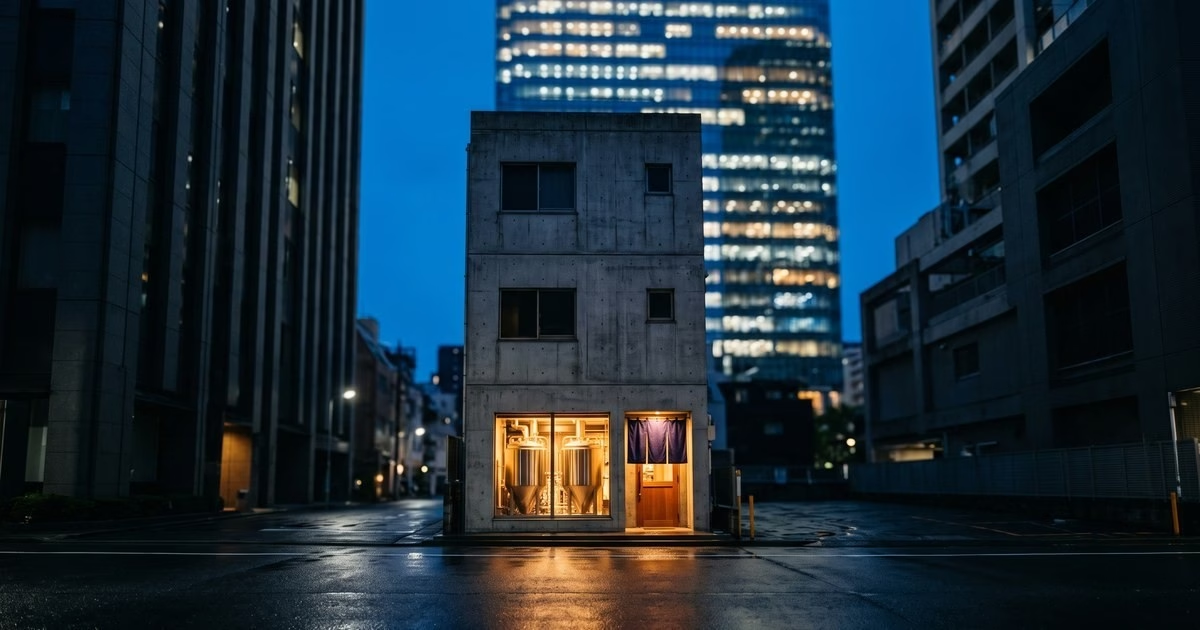
The tenth is in Minato-ku, and it makes sake with tap water.
The water gradient
We have already set Nada against Fushimi — hard water against soft, miyamizu against gokōsui, and two house styles that follow from the rock each region happens to sit on. It is the argument that underpins every regional sake identity in Japan, and it treats water as the thing you cannot negotiate with.
Tokyo contains the whole argument inside one prefectural boundary.
| 東京港醸造 Minato | 豊島屋酒造 Higashimurayama | 小澤酒造 Ōme | |
|---|---|---|---|
| Water | Municipal tap | 150 m below the Musashino Plateau | A spring inside a cave |
| Founded | 1812; dormant a century; revived 2011, licensed 2016 | House founded 1596 | 1702 |
| Setting | Four floors of concrete | Suburban west Tokyo | A wooden brewery in a river gorge |
| From Shinjuku | Minutes | Under 30 by limited express | About 80 |
A note on “oldest,” since both houses are sometimes given the title and the distinction matters. Toshimaya, 1596, is Tokyo’s oldest sake house — it began as a merchant and only moved into brewing much later. Sawanoi, 1702, is Tokyo’s oldest brewery, and says so itself. Both claims are true; they are answers to different questions.
Read that left to right and it is a transect. The city, the plateau, the mountains — and the water gets older at every step, from this morning’s mains supply, to an aquifer a hundred and fifty meters down, to a spring coming out of rock.
Three answers to the same question, forty kilometres apart, all of them Tokyo.
The brewery in Minato-ku
東京港醸造 (Tokyo Port Brewery), Shiba.
The house dates to 1812, then stopped, and the site was without a brewery for roughly a hundred years. The seventh-generation owner, Saitō Shunichi, set out to revive it in 2011 and obtained a seishu license in 2016. The brand is 江戸開城 (Edo Kaijō) — the bloodless surrender of Edo Castle — because the predecessor house, Wakamatsuya, is connected to the negotiations behind it.
What came back is not what left. The site is about 22 tsubo — roughly 73 square meters — and the brewery is a four-story reinforced-concrete building in which the process runs vertically: kōji room, tanks, press, stacked floor by floor in a working district of central Tokyo.
And the brewing water comes out of the mains. That is not an accusation — it is what the brewery says about itself. They do not bury it, and they are right not to.
It would be easy to treat it as a compromise, or a novelty. It is neither. It is a demonstration that water is a constraint a brewer works with, not a mystical prerequisite — that a brewery is a set of decisions about temperature, timing, rice and yeast, and that the water is one input among several rather than a verdict handed down by geology.
Tokyo’s mains supply is, after all, treated to a standard most of the world would envy, and it is drawn from the same Tama river system that feeds the breweries at the other end of this article. It arrives by pipe instead of through rock. The brewer’s job starts either way.
There is no tour. There is a bar.
You cannot look round Tokyo Port Brewery, and in a seventy-three-square-meter building with tanks on the floors above you, that is not surprising.
What there is instead is better. The brewery keeps a shop, open 11:00–19:00 (to 17:00 on Saturdays), and a 角打ち (kakuuchi) — a standing bar — open 18:00–21:00 on weekdays and 13:00–19:00 on Saturdays. Closed Sundays and public holidays, and, charmingly, sometimes closed when it rains. Everything the brewery makes is poured there, along with sake cocktails.
So the one brewery in central Tokyo does not show you how sake is made. It hands you a glass, in the building where it was made, ten minutes from Tamachi.
Which is arguably the most Tokyo answer available. This is a city that drinks other people’s sake by the thousand labels, and its single central brewery has responded not with a visitor center but with somewhere to stand and drink after work.
If you take one thing from this article, take this: you can drink Tokyo sake, under the tank it came from, on a Tuesday evening in Minato-ku, without booking anything.
Toshimaya, and Saturday at eleven
The Kanda shop moved into brewing properly in the Meiji era, and the brewery settled in Higashimurayama in the early Shōwa period. The water is drawn from 150 meters beneath the Musashino Plateau.
The brands are 金婚 (Kinkon) and 銀婚 (Ginkon) — golden and silver wedding, both held by the house — alongside the modern 屋守. Kinkon Masamune is the only sake offered as sacred sake to both Meiji Jingū and Kanda Myōjin.
The house also had a genuine commercial hit, three hundred years before the phrase existed. Their own 白酒 (shirozake), sold in the run-up to Hinamatsuri, set off a craze across Edo, and the saying that came out of it survives:
山なれば富士、白酒なれば豊島屋
For mountains, Fuji; for shirozake, Toshimaya.
The house also turns up in the pictures. The brewers’ association notes Toshimaya’s sake appearing in the Edo-period Edo Meisho Zue — the illustrated guide to the famous places of Edo. A shop well known enough to be drawn.
Tours run every Saturday at 11:00, ¥1,000 per person including a tasting, and no reservation is needed — excluding the New Year and summer breaks, with cancelled weeks announced in advance. They are conducted in Japanese.
The 特急小江戸 limited express from Seibu-Shinjuku stops at Higashimurayama, putting a brewery founded in 1596 under thirty minutes from central Tokyo on a reserved seat. From the station’s west exit it is about twenty minutes on foot, or a bus to Tokuzōji and ten.
Toshimaya is not a day trip. It is closer than most of Tokyo.
The English question, and what it costs
There is a second way in, and the gap between the two is worth stating plainly because nobody else will.
An operator called Sake Lovers Inc sells an English-guided version through GetYourGuide: two hours, around US$87 per person, meeting inside the brewery shop before 11:00 — so it maps onto the same Saturday slot. What you are buying is a qualified sake sommelier who interprets for the master brewer as he talks, plus a tasting of five to seven sakes, including fresh ones sold only at the brewery. Reviewers name the guide repeatedly and warmly; several mention being met at the station, and being shown somewhere good for lunch afterwards.
So: ¥1,000 in Japanese, or roughly ¥13,000 in English.
That is about thirteen times the price for translation. It is not a rip-off — a sommelier’s whole morning is a real cost, and the reviews suggest people get their money’s worth. But you should know what the two things are before you choose, and the tour page will not tell you that the brewery runs its own for a thousand yen.
Two honest cautions. Availability is thin. And among a small number of reviews, one traveller reported that no English was spoken on their departure — a single account against several detailed positive ones, but enough that you should confirm the guide before paying.
If you read some Japanese, or are happy to watch a process you cannot follow word for word, take the ¥1,000 tour. If you want the brewer’s actual explanation, pay for the interpreter. Both are legitimate. Only one of them is advertised.
Three lines, three full days
West of the city, Tokyo’s sake sorts itself by railway. Three lines run out towards the mountains, and each of them is a complete day. Not a half day — allow the whole one.
The Ōme Line
小澤酒造 (Sawanoi), Sawai Station, founded 1702. The Genroku-era brewery building survives and forms part of the tour, and the brewing water is visible where it emerges — from inside a cave.
Tours are ¥700 per person for forty minutes, closed Mondays, booked online in advance. Slots run at 11:00 and 13:00 on weekdays, and 11:00, 12:30 and 14:00 at weekends and holidays. They take around twenty people and do sell out — the live calendar regularly shows single figures remaining.
Seven hundred yen. For forty minutes inside a brewery that has been working since 1702, with the spring in the rock.
On language, be careful what you read. Several English travel sites state that Sawanoi’s tours are given in English. The brewery’s own English page says otherwise: the tour is in Japanese, with an English brochure provided. Take the brewery at its word. You are welcome, and you will be given something to read — but a guide will not be translating for you.
Its English page also gives the group size as one to ten people, which does not match the twenty-odd places the booking calendar appears to show. Assume small, and book early.
Afterwards, ままごと屋 (Mamagotoya) on the same site does a kaiseki lunch, and can be added to the visit.
Next door, Seiryū Garden Sawanoi-en has a tasting counter, a café, a restaurant and riverside seating. Cross the Kaede bridge for Kanzanji temple and the Mitake gorge path.
The mountain here is Mitake. Combine them and the day builds properly: the mountain in the morning, the brewery in the afternoon, the river in between.
Two more breweries sit further down the same line at Fussa: 石川酒造 (Ishikawa Shuzō), founded 1863, whose honkura dates from 1880 and still brews by kanzukuri, making 多満自慢 (Tamajiman) — plus restaurants and a craft beer operation — and 田村酒造場, founded 1822, brewing 嘉泉 under the house motto “make it carefully, sell it carefully.”
For the bath: 河辺温泉 梅の湯 is one minute from Kabe Station, connected directly from the north concourse — no bus, no walk — and stays open until 23:30, closing irregularly rather than on a fixed day. It is the least remarkable water in this article and the most useful, because nothing has to be rushed. もえぎの湯 at Okutama is the better bath — ¥850, riverside, spring water rising through some of the oldest strata in the country — but it closes at 20:00 in summer and 19:00 in winter, and shuts on Mondays, as does Sawanoi.
Tattoos. Ume-no-yu does not admit guests with tattoos, including stick-ons, and will remove you without a refund if it is discovered after entry. This is common at Japanese bathhouses and it is not a policy aimed at visitors — but if you have ink, check every bath on this page before you travel, and assume no unless told otherwise.
The Itsukaichi Line
A different day, and for a first visit possibly the better one.
中村酒造, brewing 千代鶴 (Chiyotsuru), was founded in 1804 and is run by the eighteenth generation. There is a brewing museum open to the public, housed in a two-story dozō storehouse built in 1884 and restored over two years. Nearest station: Akikawa.
野崎酒造, brewing 喜正 (Kishō), was founded in 1884 and is on its fifth generation, out at Tokura, using spring water off Shiroyama. No tours and no tasting — you can buy at the brewery and that is all. Worth naming precisely because it is the normal case: most Japanese breweries do not host visitors, and a guide that only lists the open ones gives a false picture of the country.
Then the Akigawa valley, and the two best baths in Tokyo: 秋川渓谷 瀬音の湯 (10:00–21:00, around ¥900 for three hours) and 生涯青春の湯 つるつる温泉 (10:00–20:00, ¥860 for three hours, closed the third Tuesday), the latter promising — and by most accounts delivering — the smooth skin its name claims.
An 1804 brewery, an 1884 museum, a river valley, and the best bathing in the prefecture. No compromise anywhere in it.
The Seibu Shinjuku Line
Toshimaya, above. And if you keep going — change at Tokorozawa for the Ikebukuro Line — the track carries on to Chichibu, which has breweries of its own, including one whose spring is listed among Japan’s Heisei hundred famous waters.
Which is the water gradient continuing straight past the prefectural border. That is a different article.
Two ways to sleep
Tokyo’s sake country offers two kinds of night, and they are opposites.
酒坊 -多満自慢- opened in July 2021 inside the grounds of Ishikawa Shuzō at Fussa. Three private Japanese rooms — Matsu, Tsubaki, Fuji — from ¥14,300 per room, and capsule dormitories, Ume for women and Sakura for men, from ¥6,050 per person. The on-site Kitchen & Bar Tanomi pours the brewery’s sake and its craft beer.
You can sleep inside a Tokyo sake brewery for six thousand yen.
The other is 岩蔵温泉, the only onsen village in Tokyo, with twelve hundred years behind it — the legend has Yamato Takeru bathing here to clean his wounds, and the site is protected by the city.
One inn is still open. It is called 儘多屋 (Mamadaya), it was founded in 1883, and it sits by the Kurosawa river on the old road between Ōme and Hannō. The story of the place is that a traveling doctor of Chinese medicine found the spring and set up here. The water carries metaboric acid, fluoride and sodium bicarbonate; no strong smell, and gentle enough for children.
The building keeps its original materials and has added a few things of its own — jazz in the lobby, rooms designed one at a time. Day visits are currently suspended; overnight only, which is the whole point. It also takes whole-inn bookings.
From JR Higashi-Ōme, the Seibu bus toward Hannō, twenty minutes, then two on foot.
Japan had 1,104 working sake breweries in brewing year 2024, and the number falls every year. Iwakura is the same arithmetic, told in water instead of sake, twenty minutes from a brewery that has been running since 1702.
Practical
- Allow the full day for any of the three lines. These are not afternoon excursions.
- Book Sawanoi well ahead. The calendar is Japanese; so is the tour.
- Mondays are bad. Sawanoi, Moegi and several others close.
- Toshimaya runs Saturdays at 11:00, ¥1,000, no booking.
- Carry cash west of the city.
- Do not eat nattō before a brewery visit. There is a real reason for this.
Tokyo is supposed to be the place sake arrives — the export market at home, the city where every prefecture’s bottles compete on the same shelf. It is that. It is also a place where sake is made from tap water in Minato, from a deep aquifer in Higashimurayama, and from a cave in Ōme, and where the word for the room you drink it in was coined by a shop that is still trading.
So which water would you rather drink from — the spring in the rock, or the one that comes out of the tap in Minato and does the job anyway?
Related: What Actually Happens on a Sake Brewery Tour? · Every Sake Brewery in Japan