How to Order From a Sake List You Cannot Read
You are sitting down. Someone hands you a list. It is a column of kanji and a column of prices, and there is nothing else on it.
The instinct is to treat this as a reading problem. It mostly isn’t. Even people who read Japanese fluently cannot tell, from most izakaya lists, how much sake they are about to be brought or what it will taste like. The information is missing, not encrypted.
So here is what is actually on the page, what has been left off, and how to order anyway.
The big characters are a brand, not a producer
The name is the 銘柄 (meigara), and it works more like a wine’s label than its estate. Dassai is a brand; the company is Asahi Shuzō. Jūyondai is a brand; the brewery is Takagi Shuzō. One brewery may run several.
Learning brands by sight is how everybody navigates sake in Japan, Japanese drinkers included. There is no shortcut, but there is a smaller number to learn than it looks — a few hundred appear regularly, and recognition builds fast.
What may or may not be printed
If the list offers technical information at all, it will be some of this — and each has its own guide here, so we will not repeat them:
- The classification — junmai, honjōzō, ginjō, daiginjō. Tells you about alcohol addition and polishing; tells you nothing about sweetness.
- 日本酒度 and 酸度 — read as a pair or not at all. SMV alone will mislead you.
- The prefecture — more useful than it looks, if regional styles mean anything to you yet.
- 生 / 無濾過 / 原酒 — these tell you more about what lands in the glass than the classification does.
Most lists give you one or two of these. Many give none.
The part that actually costs you money
Here is the thing worth knowing before anything else: the serving size is frequently not stated.
Your possible pours:
| グラス glass | No fixed size. Often around 90 ml or 120 ml. |
| 一合 ichigō | 180.39 ml — the legal unit, and the standard. |
| 徳利 tokkuri | The flask. One gō, sometimes two. Ask. |
| 枡 masu | The wooden box — sometimes the vessel, sometimes sitting under a deliberately overfilled glass. You are getting more than you can see. |
So when one sake is ¥800 and the next is ¥1,200, that is not necessarily a quality gap. It is very often a glass next to a full gō.
Confirm the unit before you conclude anything about the price. And bear in mind that a gō carries roughly half again the alcohol of a five-ounce wine pour, in a vessel that looks smaller.
How lists are organized
Rarely by style. In practice:
- By brewery or region — the most navigable, and a sign someone built this list on purpose
- By 甘口 / 辛口 (sweet/dry) — crude, but a handle
- By price — tells you nothing
- By nothing at all — a handwritten column in no order. Frequently the best places.
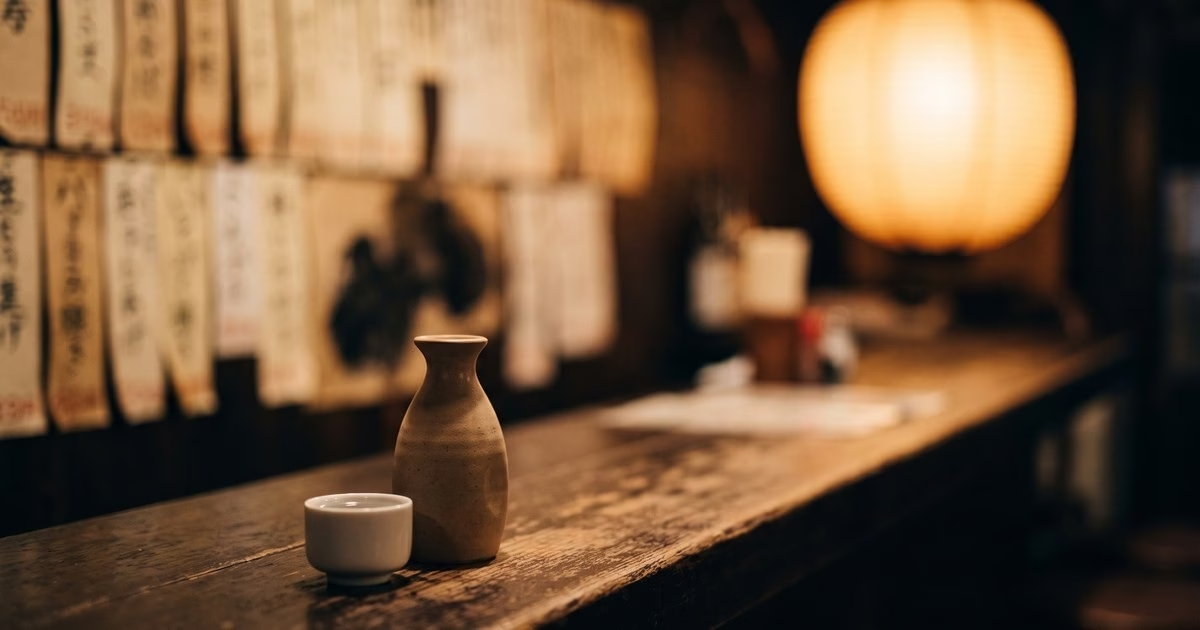
And one rule that holds almost everywhere: the printed menu is not the whole list. Seasonal bottles, unpasteurized stock, the thing that arrived on Tuesday and will be gone by Sunday — those are on a chalkboard, a clipboard, or a strip of paper taped to the wall.
If there is a board, the board is the list. Point at it.
The order that always works
飲み比べセット (nomikurabe setto) — a tasting flight. Usually three small pours, often themed: three from one prefecture, three classifications from one brewery, three points on a dry-to-sweet line.
It is cheaper than three glasses. It is built to be compared. And ordering it tells the room you are interested rather than lost, which changes the service you get for the rest of the night.
On an unfamiliar list, this is almost always the correct first move.
When you can read none of it
Photograph the list. Not to translate it character by character — to recognize the names next time. This is how a working vocabulary accumulates, and it is faster than studying.
Find 飲み比べ. Worth learning to recognize as a shape.
Give two adjectives and let them choose. Light and dry. Rich and warm. Fruity and cold. Paired with what you are eating, that is enough information for anyone behind a counter to do better than you would have. Ordering is covered properly here.
Accept that the first glass is a guess. It will cost under ¥1,000, and a wrong guess is not a waste — it is the only way anyone has ever learned this.
The list is not hiding anything from you. It was written for a reader who was expected to ask, in a room where asking is the normal thing to do.
So: do you want to read the wall — or the board behind it?
Related: Decode the Label · The Sake Lexicon · What Is an Izakaya?