How to Book a Sake Brewery Visit in Japan (And Why So Many Say No)
Japan had 1,104 working sake breweries in brewing year 2024. You can visit perhaps a few dozen of them without knowing somebody.
That gap surprises people, and it produces a specific kind of disappointment: you find a brewery whose sake you love, you email, and either nothing comes back or a polite refusal does. It is easy to read that as a door closed to foreigners.
It usually isn’t. The reasons are structural, and once you understand them you can work with them.
A brewery is not a museum
The first thing to understand is what you are asking to enter.
A sake brewery in season is a working food-production facility running a live microbial process. Kōji is cultivated in a warm room at around 30°C over roughly 48 hours, with someone checking it through the night. The main mash ferments for three to four weeks. None of it can be paused because a visitor arrived.
Most breweries are also small. The industry’s shape is a few large houses and a very long tail of family operations, many with fewer than ten staff. There is no tours department. The person who would show you around is the person currently moving rice.
So “no” is very often “no capacity,” not “no foreigners.”
The nattō problem is real
The most-repeated rule about brewery visits is the one people assume is folklore: do not eat nattō before you go.
It is not folklore. Nattō is made with Bacillus subtilis var. natto, which forms spores that are extraordinarily robust — they survive heat and desiccation that kill most organisms — and it grows fast. Sake depends on Aspergillus oryzae, the kōji mold, colonising steamed rice cleanly. Introduce a vigorous Bacillus into that room and it can out-compete the mold the entire process rests on.
Breweries therefore ask visitors to avoid nattō, and often yoghurt and other fermented foods, for 24 hours before arriving. Many also ask you not to wear perfume or cologne.
This matters for booking in a way that is rarely spelled out: a brewery has no way to verify that a stranger followed the rule. A tour is a small act of trust, and for a house whose entire year of production sits in those tanks, the downside is total. Some simply decide the maths doesn’t work.
The season paradox
Here is the trade-off nobody tells you before you plan.
Most breweries brew from roughly October to March. That is when there is something to see: rice steaming at dawn, kōji in the warm room, a tank of moromi audibly working.
It is also when they have the least time for you. Some breweries suspend tours entirely during peak season.
Visit in summer and the opposite is true. Booking is easy, staff are relaxed, you may get an hour with the tōji instead of fifteen minutes with a guide. But the tanks are empty and clean, and you are looking at equipment.
| Oct–Mar | Apr–Sep | |
|---|---|---|
| See brewing | Yes | No |
| Book easily | Hard | Easy |
| Staff attention | Minimal | Generous |
| Taste new sake | Yes — shiboritate | No |
If you want one recommendation: late February to mid-March. Brewing is still running, the punishing early-season weeks are over, and the new sake is out.
Read the cedar ball
There is a signal hanging over the door of most breweries that almost every visitor walks past.
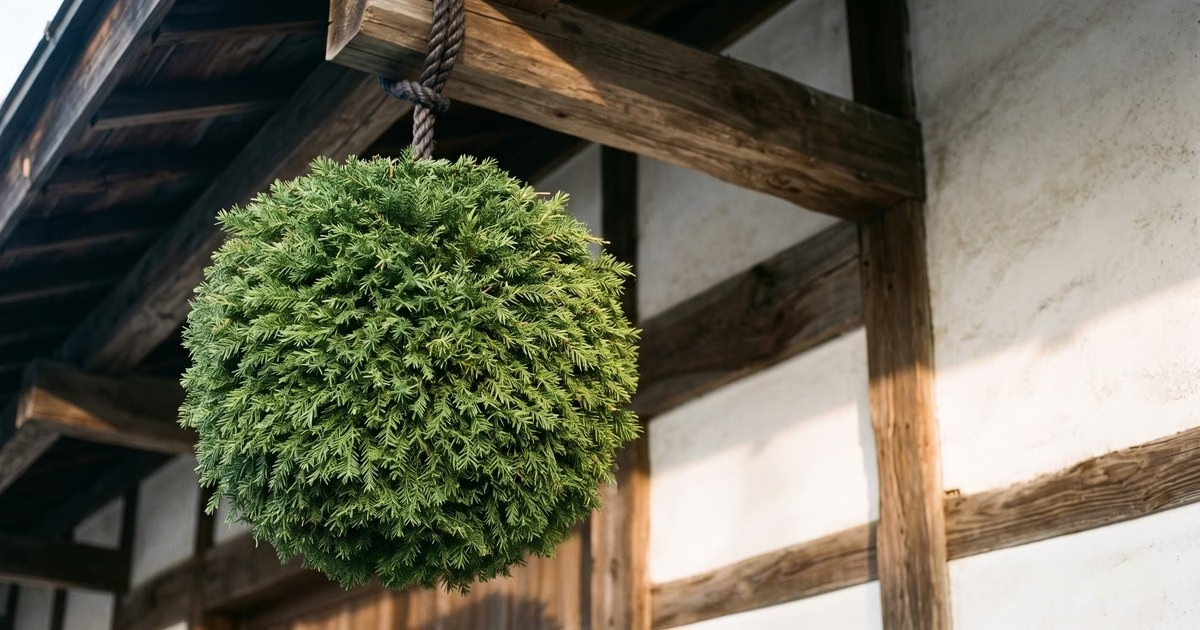
A 杉玉 (sugidama) — also called 酒林 (sakabayashi) — is a ball of cedar branches. The custom originates at Ōmiwa Shrine in Nara, dedicated to the deity of sake, and spread to breweries nationwide from the early Edo period.
It is not decoration. It is a clock.
A fresh sugidama is hung when the year’s first sake is finished, around late November, and it is green. Over the following months the needles dry and the ball fades — through pale brown in spring, to deep brown by autumn, which is the season for ひやおろし (hiyaoroshi), sake rested through the summer.
So the color of the ball tells you where in the brewing year you are standing. Green means the new sake has just arrived. Brown means it has been sleeping since spring.
Once you can read it, you can tell from the street.
The four ways in
1. Breweries with permanent visitor facilities
A small number of large houses run proper museums with fixed hours, admission, tastings and English signage. Gekkeikan and Kizakura in Fushimi, Hakutsuru and others in Nada, and a scattering elsewhere.
These are easy — online booking or walk-in — and they are the right first brewery for most people. The trade-off is that you are seeing a heritage exhibit and a demonstration line, not the working brewery.
Book online where offered. Several now run timed-entry slots, and walk-in capacity is not guaranteed.
2. Small breweries, by direct arrangement
This is where the interesting visits are, and where the friction is.
Expect: telephone rather than email, Japanese rather than English, weeks of notice rather than days, and a request for a firm party size. Many take a minimum of two people. Some will ask what you already know about sake — not as a test, but to pitch the visit.
If you do not read Japanese, this is genuinely hard, and pretending otherwise does you no favours. Options: ask your accommodation to call, use a regional brewers’ association as an intermediary, or accept that this tier may not be available on this trip.
3. Regional associations and organized tours
Prefectural brewers’ associations increasingly coordinate visits, and some regions have built proper sake tourism programs with English support. Niigata is the most developed; several breweries there accept walk-ins during opening hours without a reservation at all.
A paid tour operator is a legitimate answer if the alternative is not going. Just know what you are buying: access and translation, at a markup.
4. 蔵開き — the open house
The workaround almost nobody outside Japan uses.
蔵開き (kurabiraki) is a brewery open day. The doors come off, the courtyard fills, there is food and usually a queue, and you do not need an individual booking at all. Many fall between January and April, timed to the new sake.
You will not get a quiet conversation with the tōji. You will get inside a working brewery, on a day it is set up for exactly that, without a single phone call. For a first visit, that is a good trade.
Check the brewery’s own site and social accounts. These are local events, often announced only in Japanese and only a few weeks ahead.
What to ask when you book
- Is the tour of the production area, or the museum? Different things, often the same price.
- Is there a tasting, and is it included?
- Any dietary or scent restrictions? Assume nattō; confirm the window.
- How long? Twenty minutes and ninety minutes are both common.
- Language? Ask directly. Many will say Japanese only — better to know.
- Can you buy on site? Often the point. Brewery-only bottles and unpasteurized stock rarely travel.
- Photography? Frequently restricted in the kōji room.
On the day
Arrive early. Don’t wear fragrance. Don’t touch equipment. Expect to be asked to remove shoes, cover your hair, or step through a sanitising mat.
And buy something. A small brewery that gave you an hour did not do it for the ticket price.
The honest summary
Most breweries will not host you, and that is not a slight. The ones that do are offering access to a live process that could be ruined by a stranger’s breakfast — which is why the rules are strange and the answer is often no.
Aim for late winter. Read the cedar ball on the way in. Go to an open house if the phone call is beyond you.
When you picture a brewery visit, is it the machinery you want to see — or the twenty minutes with the person who runs it?
Related: What Actually Happens on a Sake Brewery Tour? · Every Sake Brewery in Japan