
Does Glassware Change How Sake Tastes?
Glass shape really does change what reaches your nose, but not for the reason the marketing says. A sniffer-camera study on ethanol vapor, and why the small cup is not a lesser choice.
Glass shape really does change what reaches your nose, but not for the reason the marketing says. A sniffer-camera study on ethanol vapor, and why the small cup is not a lesser choice.
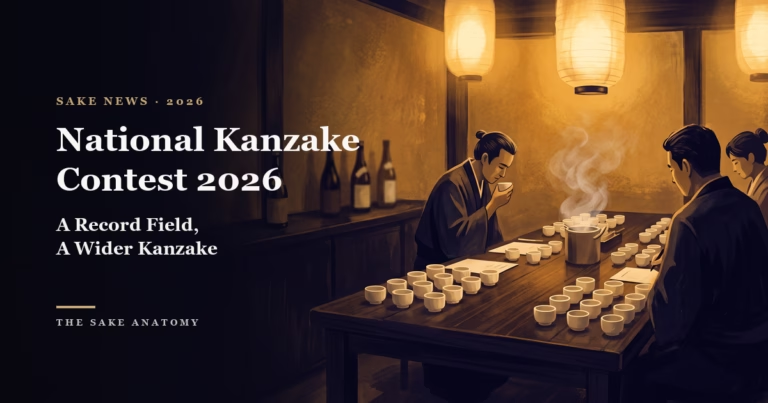
Japan’s only competition dedicated entirely to sake served warm, the National Kanzake Contest (全国燗酒コンテスト), held its 17th judging on August 4, 2026 — and this year’s results point to a real shift in how the category is being defined. The numbers 227 breweries submitted 971 entries this year, judged blind by a panel of 54…
Warm sake in a water bath off the boil, aiming for about 40C. The usual failure is overheating, not the method – and the microwave is not the villain.
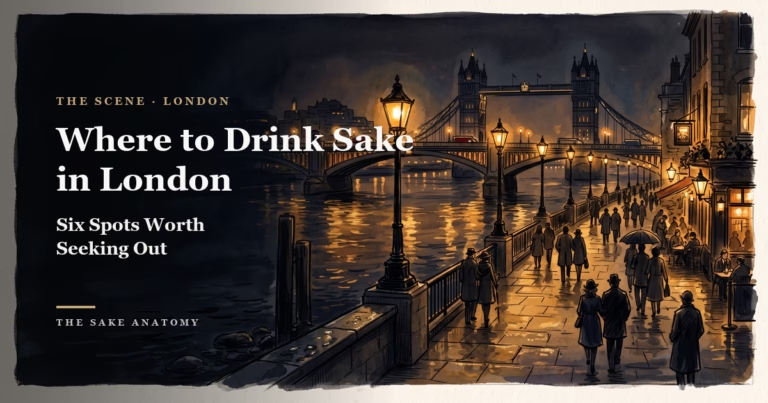
London’s serious sake scene doesn’t sit in one walkable cluster — it runs from a working brewery under a railway arch near London Bridge to a Michelin-starred kaiseki room in Mayfair, by way of a bottle shop with its own bar in Covent Garden. That spread says something: sake here is still a specialist pursuit,…
The East Village was Manhattan’s working-class Lower East Side spillover before it became the city’s countercultural engine room — punk clubs, poets, and the kind of cheap rent that let a neighborhood get weird for a few decades. Some of that rent is gone, but the low-key, do-your-own-thing character stuck around, and it shows in…
Shibuya is the loudest neighborhood on this list by a wide margin — the scramble crossing, the wall of screens above it, department stores stacked ten stories high. It is also one of Tokyo’s biggest rail hubs, which is precisely why the drinking scene tucked into its backstreets, particularly the slope of Dogenzaka rising away…
Kagurazaka sits on a steep hill in Shinjuku ward, a few minutes’ walk from Iidabashi Station, and it doesn’t feel like the rest of Tokyo. The neighborhood grew up as a geisha district in the Edo and Meiji periods, and the layout still shows it: a stone-paved main slope lined with old shopfronts, forking off…
Sake sulfites explained: Japanese law caps residual SO2 in sake at under 30 ppm, versus 350 ppm for fruit wine — and brewers rarely add any. Here is the science.
How to order sake at a restaurant without memorising brand names: the three questions to ask your server, what a go actually pours, and how to read a sake list.
Sake yeast makes the alcohol and almost all of the aroma. Here is what strain numbers like No. 6, No. 7 and 1801 mean, and why yeast choice shapes the bottle.