
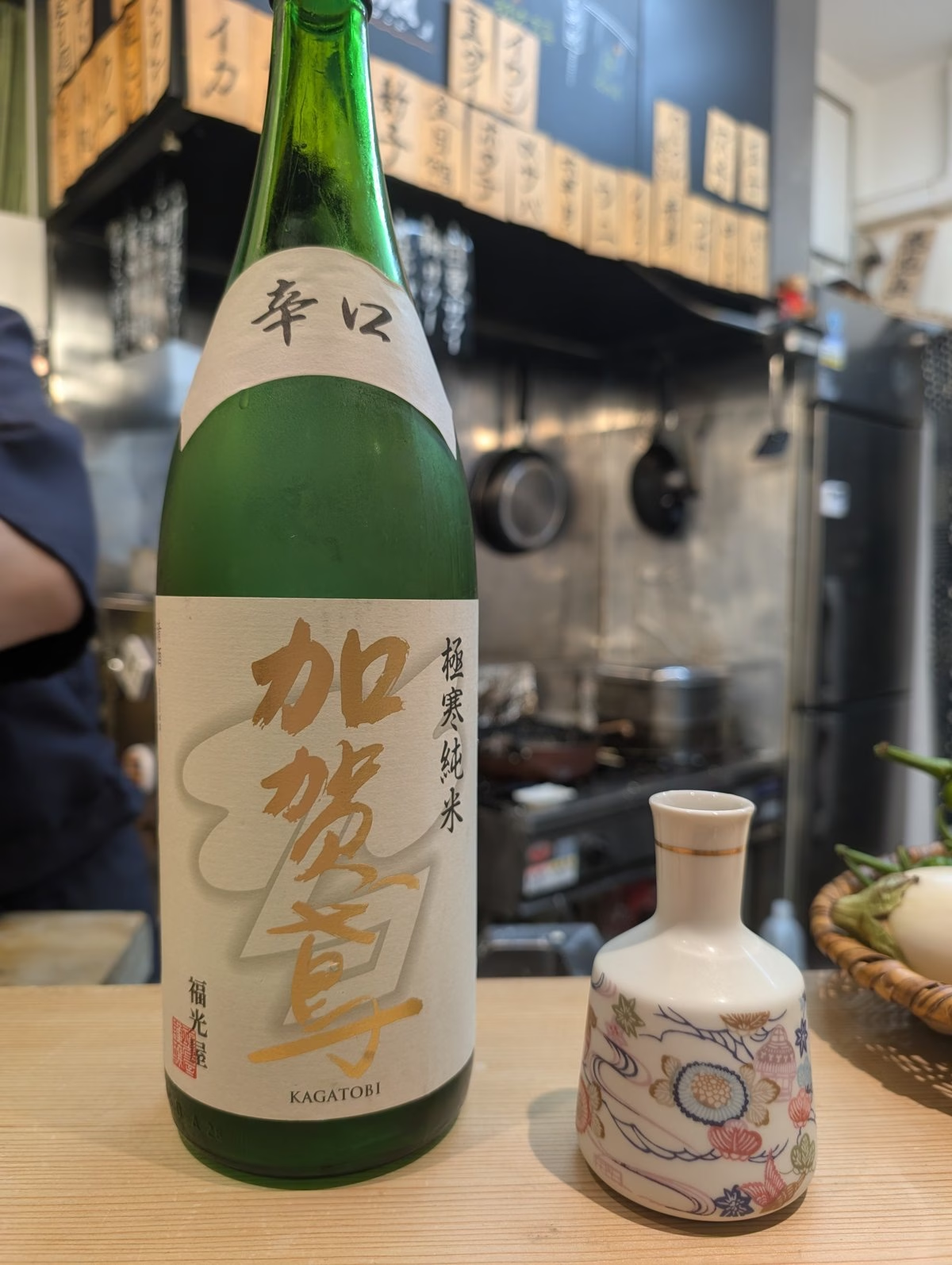
What does “gokkan” promise on a bottle of Kagatobi?
One Bottle, Decoded
Two characters sit above the word junmai on this label: 極寒, gokkan, “the depth of winter.” It reads like mood-setting copy, the kind of word a designer adds because it looks good in gold. It is not. It is a statement about when, and at what temperature, this sake was fermented, and it is one of the oldest production choices in Japanese brewing. Read together with the numbers on the back label, it tells you most of what to expect before the glass is poured.
The bottle
| Brand | Kagatobi 加賀鳶 Gokkan Junmai Karakuchi 極寒純米 辛口 |
| Brewery | Fukumitsuya 福光屋, Kanazawa |
| Prefecture | Ishikawa |
| Grade | Junmai |
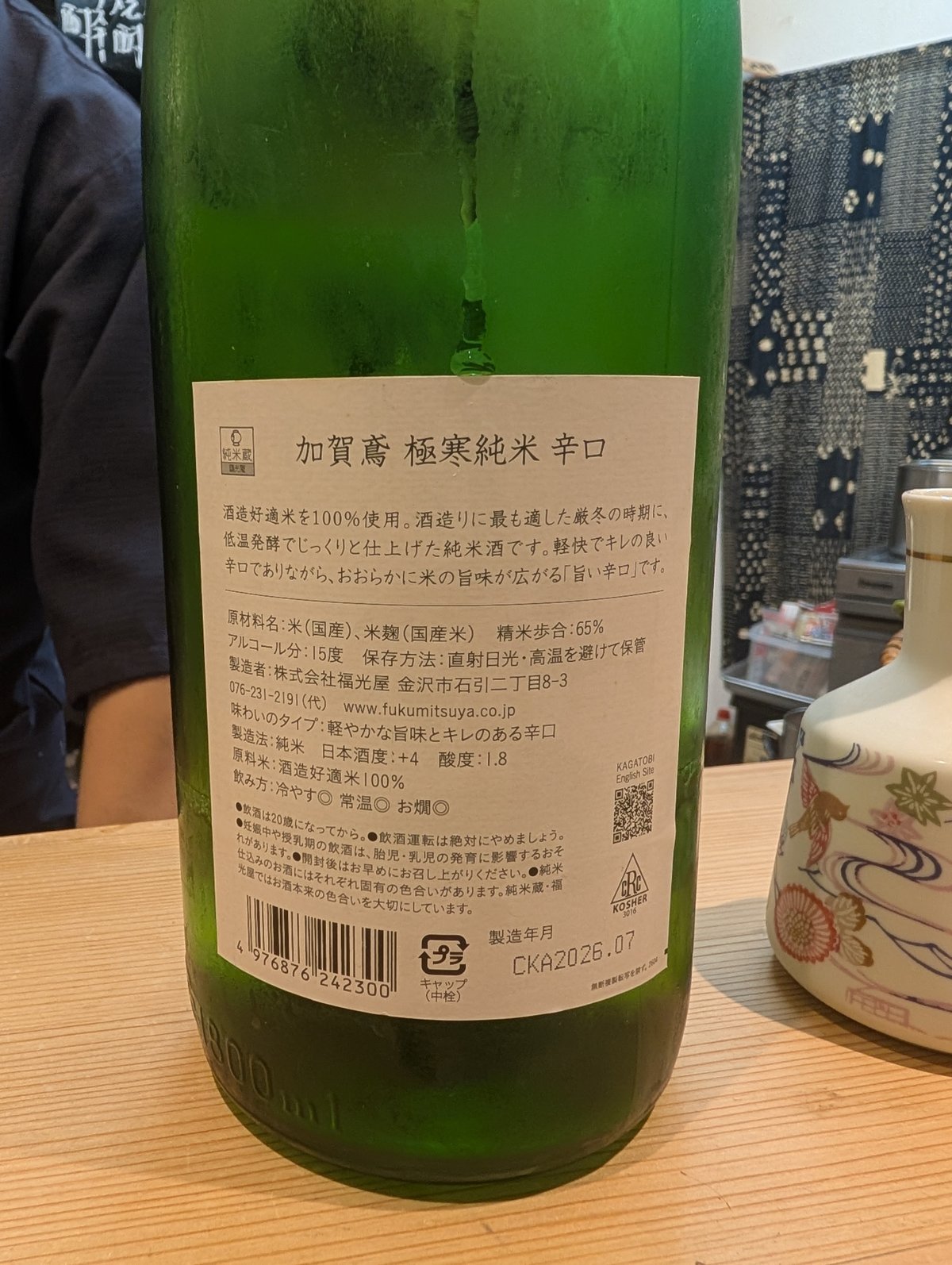
| Rice | Sake-brewing rice (酒造好適米), 100%, domestic |
| Polishing ratio | 65% |
| ABV | 15% |
| SMV (Nihonshu-do) | +4 |
| Acidity | 1.8 |
| Bottling date | July 2026 |
| Serving (per label) | Chilled ◎ · Room temperature ◎ · Warm ◎ |
→ Fukumitsuya (Kagatobi) brewery profile · Kagatobi in the Sake Brand Index
Reading the label
極寒 gokkan: brewing in the cold
Sake can technically be brewed at any time of year in a modern temperature-controlled brewery. Traditionally, it was not. The practice of kanzukuri 寒造り, brewing in the coldest months, became the norm during the Edo period, and it stuck for good reasons that have nothing to do with romance.
A sake mash is an open system. Rice, koji, water and yeast sit in a tank where sugar is being made and consumed at the same time, and anything else that can live on sugar would like to join in. Cold air does two things at once. It slows the yeast, which stretches fermentation out over weeks and gives the brewer more control over how fast alcohol and flavor compounds build up. And it suppresses the unwanted bacteria that thrive in warmth. The practical result is a cleaner, more deliberate ferment.
“Gokkan” on this label is Fukumitsuya’s shorthand for exactly that: a junmai brewed in deep winter and fermented slowly at low temperature. It is a process claim, not a legal category. There is no statutory definition of gokkan, in the way there is for junmai or ginjo. It tells you how the brewery chose to work, and it points toward a style: tidy, restrained, without the heavy, cooked-rice character that a faster, warmer ferment can leave behind.
+4 and 1.8: two numbers that only make sense together
The back label gives an SMV (nihonshu-do 日本酒度) of +4 and an acidity (sando 酸度) of 1.8. Most readers treat SMV as a sweetness dial. It is not quite that.
SMV is a density measurement. It compares the weight of the sake to the weight of water: the more dissolved sugar left in the liquid, the heavier it is, and the lower (more negative) the number. A reading of +4 means relatively little residual sugar, which is why the front label is entitled to say 辛口 karakuchi, “dry.”
But dryness on the palate is not set by sugar alone. Acid cuts across sweetness, so the same SMV can feel noticeably drier or softer depending on how much acidity sits beside it. At 1.8, this bottle carries a fairly firm acid line for a junmai of this kind. Put the two numbers side by side and the prediction is a sake that reads dry partly because there is little sugar, and partly because there is enough acid to finish it off cleanly. The brewery’s own description on the back label points in the same direction: a light, crisp dry style in which the rice’s savoriness still opens up.
That is the useful habit to take from any label that publishes both figures. Never read SMV alone. Read it against acidity.
純米蔵 junmai-gura: the badge in the corner
In the top-left corner of the back label is a small square mark reading 純米蔵, junmai-gura, “junmai brewery.” It describes the brewery rather than the bottle.
Adding distilled alcohol to sake became widespread in Japan during the wartime rice shortages of the 1940s, and alcohol-added styles still make up the majority of production today. Fukumitsuya, founded in Kanazawa in 1625 and the city’s oldest brewery, stopped adding alcohol to any of its sake from the 2001 brewing year onward. The brewery states that it was the first brewery of its production scale in Japan to go all-junmai.
So on any Fukumitsuya label, junmai is not a premium tier sitting above cheaper alcohol-added bottlings. It is the only thing the brewery makes.
加賀鳶 Kagatobi: the name
Kaga-tobi were the firefighters maintained by the Kaga domain at its residence in Edo, famous for their showmanship and their nerve on rooftops. The name was later borrowed for a well-known kabuki play. Fukumitsuya launched the brand in the 1990s and built it as a line of dry sake. The name is a piece of Kanazawa history. It does not describe the liquid, but it does tell you where the brand wants to stand: bold, local, and dry.
What the label does not say
The label does not name the rice variety, only that it is brewing-grade rice. It also does not say whether the sake was pasteurized, although nothing on the bottle marks it as nama. And the date printed on the label is the bottling date, not the brewing date. A July 2026 bottling tells you when the sake left the tank for the bottle, not when it was made. For a full walk-through of these fields, see Decode the Label.
Where and how
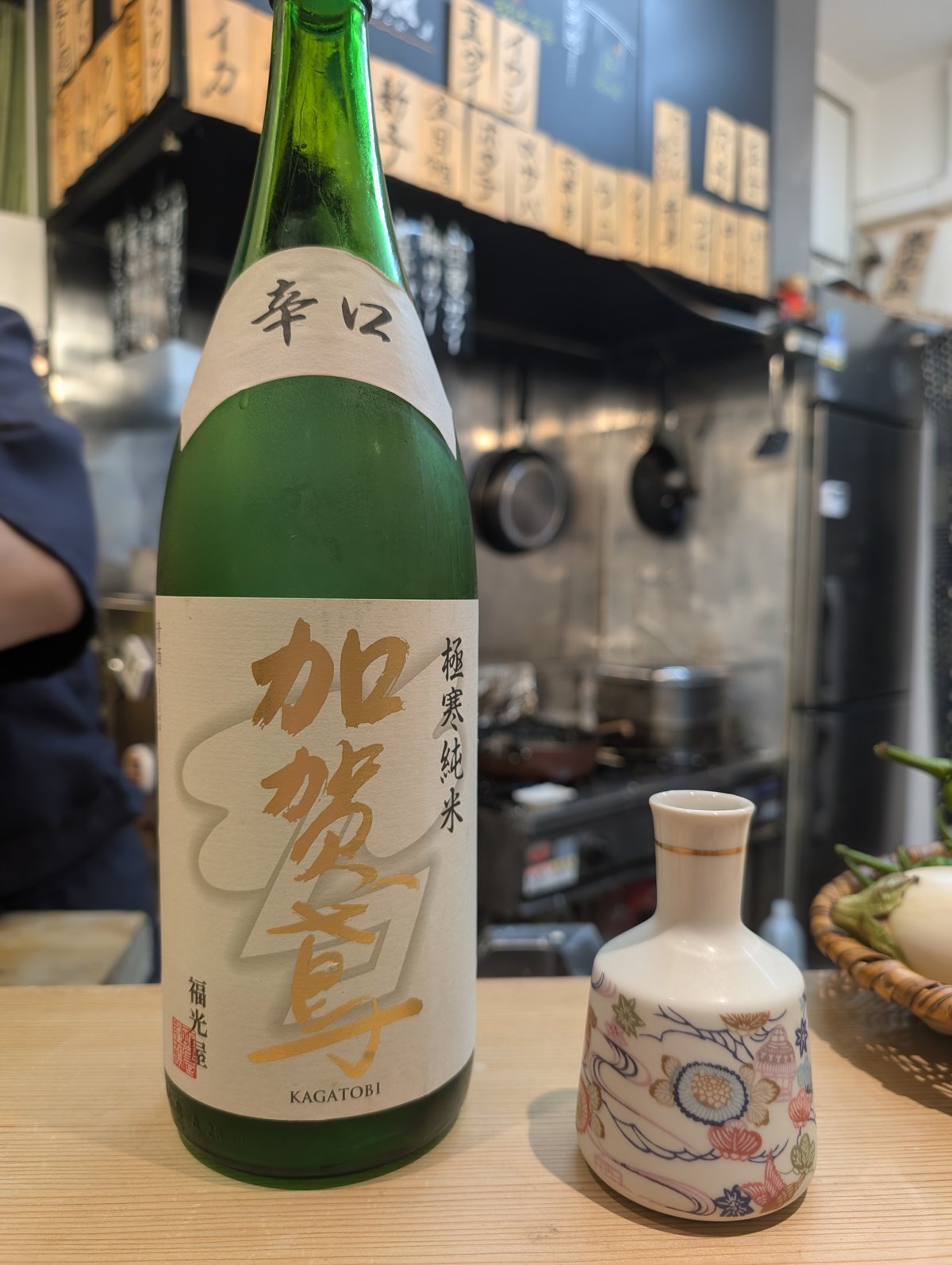
Osushiya Taiki おすしや太喜, Takadanobaba, Tokyo. First week of September 2026.
Served chilled, with sushi. At a sushi counter the choice of a dry junmai is not an accident: nigiri is built from vinegared rice and delicate fish, and a sake with little residual sugar and a clean acid line tends to reset the palate between pieces rather than sit on top of them.
The pour came in a tokkuri, a small ceramic flask. It is worth saying out loud because a tokkuri is so strongly associated with warm sake that many readers assume anything poured from one has been heated. It had not. The vessel tells you how the sake is served, not at what temperature.
Tasting notes
An honest admission first. My notes from that evening came down to a single word: umakara 旨辛, “savory-dry.” Everything finer than that did not survive the night, and I would rather tell you so than reconstruct a set of aromas I cannot vouch for.
What makes that one word interesting is that it lines up almost exactly with what the label promised. The brewery describes this sake as a light, crisp dry style in which the rice’s savoriness still spreads out, and it calls the result an “umai karakuchi,” a dry sake that is also savory. The numbers point the same way. An SMV of +4 predicts dryness, an acidity of 1.8 predicts a clean finish, and a slow, cold ferment predicts restraint rather than perfume.
So this is less a tasting note than a check on the label. The label predicted umakara, and umakara is what a distracted drinker at a sushi counter, paying more attention to the fish than to the glass, still remembered. For a back label, that is a reasonable result.
| Dry → Rich | ●●○○○ 2/5 |
| Light → Full | ●●●○○ 3/5 |
| Subtle → Aromatic | ●○○○○ 1/5 |
| Low → High acidity | ●●●○○ 3/5 |
The bars place this bottle on each axis, drawing on the label’s published figures, the brewery’s own description and a recollection from the night; they are a position, not a score.
Before you pour your own
A label that says “winter” and prints two numbers is making a prediction about the glass. On this evening, the prediction survived even a poor memory. Whether it holds for you depends on things the label cannot control, such as the temperature it reaches you at, the cup, what you are eating, and how long the bottle has been open.
So: the next time a back label gives you both SMV and acidity, will you read the two numbers together before you taste, and see whether your palate agrees with them?
Paid for at the restaurant. This is a record of one bottle on one evening, not a recommendation. No brewery or venue was involved in this piece.
Follow along on Instagram at @thesakeanatomy.